


StudentsReview OFFICIAL Rankings
New Years Day, 2005
* Best All-Around Education *
StudentsReview biases its Education rankings
heavily towards Educational Quality, and Academic Success based upon actual
understanding. Many institutions neither try educate students, nor insure
that academic performance matches actual understanding. These failures harm
students significantly. (see bottom)
 Purpose
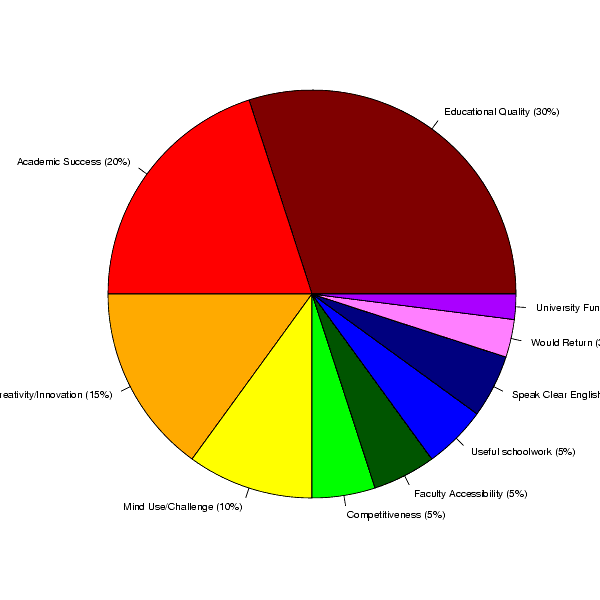
The schools that provide the best “all around” education
are those that excel in educational quality, academic success, and
innovation for most groups of students — men, women, instate,
out-of-state, international, and so on. The factors that constitute
a valuable education for the future are described below.
There should be some surprises, which mean that those
schools are doing unexpectedly well for their students, regardless
of a large national reputation.
Discuss these Rankings!
StudentsReview Advice!• What is a good school?• Statistical Significance • How to choose a Major • How to choose your Career • What you make of it? • How Ivy League Admissions works • On the Student/Faculty Ratio • FAFSA: Who is a Parent? • FAFSA: Parent Contribution • FAFSA: Dream out of reach • College Financial Planning • Survive College and Graduate • Sniffing Out Commuter Schools • Preparing for College: A HS Roadmap • Talking to Your Parents about College. • Is a top college worth it? • Why is college hard? • Why Kids Aren't Happy in Traditional Schools • Essential College Tips Ah, college. Considered by many to be the time of a young person's lif... more→ • Cost of College Increasing Faster Than Inflation• For parents filling out the FAFSA and PROFILE (from a veteran paper slinger)Just so you know, filling out these forms is a lot more than penciling... more→ • How to choose the right college?My name is Esteban Correa. I am currently a second year INTERNATIONAL ... more→ • Create The Right Career Habits NowGetting ahead in your career can be easier if you make the choice to b... more→ • Senior Year (Tips and experience) It's the end of junior year and everyone is anticipating the arrival o... more→ • Informational Overload! What Should I Look For in a College or University?We are in an instant information age, where you can find almost anythi... more→ • Personality Type and College ChoicePersonality type is something very important to consider when deciding... more→ • A Free Application is a Good Application As a senior finishing her scholastic year, I feel that it is my duty ... more→ • College Academic Survival Guide The leap from high school to college academics is not an insignificant... more→ • Getting Involved: The Key to College HappinessAs a tour guide, the absolute, most frequently asked question I got wa... more→ • Choose a Path, Not a MajorUnless you're one of the fortunate souls who's already found their cal... more→ • The Scoop on State SchoolsA recent college graduate, I vividly remember touring campuses as a
p... more→ • The Purpose of a Higher Education You are one of the millions of people this year applying for admission... more→ • The Importance of Choosing the Right College Major (2012)One of the most important academic choices you'll make while in colleg... more→ • How to choose a college majorI was not sure what college major to choose. When you are in your late... more→ • How to guarantee your acceptance to many collegesAre your grades are not what you think they should be from high school... more→ • Nailing the College Application Process College applications seem to always be put on top of students procrast... more→ • What to do for a Successful InterviewInterviews seem to become more commonplace in every facet of life as o... more→ • I Don't Know Where to Start (General College Advice)Preparing for college is a difficult time for every student and it?s o... more→ • Attitude and Dress Code for an Interview (General College Advice) An interview is something we all have to go through when we get a job... more→ • Starting College (General College Advice) College is a huge milestone in your life. You?ve seen the castle like ... more→ • Boston Apartment lease: Watch out!Are you a student and about to sign the very first lease in your li... more→ When thinking about their choices for colleges, many students and pare... more→ |

